
There’s nothing quite like turning on your heater on the first cold morning of the season and getting a blast of cold air in return. Car heater repair is something Valley City Automotive in Eau Claire, WI, sees every fall, and the good news is most heating problems come down to five well-known causes: low or degraded coolant, a compromised heater core, a failing blower motor or resistor, a stuck blend door, or a clogged cabin air filter. In this guide, we’ll walk you through how your heating system works, what each failure actually feels like from the driver’s seat, why simply topping off your coolant isn’t enough, and what a proper heating system evaluation covers so you head into winter with confidence.
How Your Car's Heating System Actually Works
Most drivers assume the heater is its own separate system. It’s not.
Your car’s heater is directly tied to the engine’s cooling system. Here’s the short version of how it works:
- Your engine produces heat as it runs
- Coolant absorbs that heat and circulates through the engine
- A portion of that heated coolant flows through the heater core, a small radiator-like component tucked inside the HVAC assembly behind your dashboard, near the firewall
- The blower motor pushes cabin air across the heater core fins, warming the air before it enters your vehicle
The result: Warm air for you, a cooler engine under the hood.
The problem: If anything in that chain breaks down, you lose heat. And in Eau Claire, WI, that’s not just uncomfortable. It’s a safety issue.
Why Wisconsin Winters Are Unforgiving on Heating Systems
Eau Claire drivers deal with temperature swings that stress vehicle systems in ways that warmer climates never see. Coolant contracts in the cold. Rubber hoses and seals become brittle. Heater cores that were marginal all summer can fail completely when temperatures drop below freezing.
A heating system that “sort of worked” in October can leave you completely without heat by January.
That’s why fall is the time to get it tested, not after the first cold snap hits.
The Most Common Reasons Your Heater Stops Working
Low or Degraded Coolant
This is the most frequent cause of a car heater blowing cold air. If coolant levels are low, there isn’t enough fluid to properly transfer heat through the heater core. But even a full coolant reservoir can be a problem if the fluid itself has degraded.
Over time, coolant becomes acidic. It starts eating away at the inside of the cooling system, corroding components quietly and reducing the system’s ability to hold and transfer heat effectively. A coolant exchange at the right interval is one of the most preventative things you can do for your entire cooling and heating system.
A Failing or Blocked Heater Core
The heater core is one of the most overlooked components in the entire vehicle. When it starts failing, the symptoms can be subtle at first:
- A sweet, syrup-like smell inside the cabin
- Foggy windows that aren’t caused by moisture or weather
- Cold air from the vents despite a warm engine
- Coolant loss with no visible leak under the hood
A blocked heater core is often caused by years of neglected coolant that’s left deposits inside the passages. A failed heater core can also leak coolant directly into your cabin. Either way, this isn’t a “wait and see” situation.
Blower Motor or Resistor Problems
You can have a perfectly functioning heater core and still get no airflow. The blower motor is what pushes air across the core and into your vents. A blower motor that’s failing might:
- Work only on high speed
- Make grinding or rattling noises
- Cut out completely or operate intermittently regardless of the speed setting
- Stop working entirely
In many cases, the issue is actually the blower motor resistor, a small component that controls fan speed. Testing the blower motor circuit is a straightforward electrical evaluation that tells us exactly what’s failed and what hasn’t.
Blend Door or Blend Door Actuator Failure
Your HVAC system uses a component called a blend door to control how much air gets routed through the heater core. When you adjust the temperature dial, a small electric motor called the blend door actuator moves that door. If the actuator fails or the door itself gets stuck in the cold-air position, the blower motor will push air right past the heater core without it being heated at all.
You can have full coolant, a working thermostat, a clear heater core, and a functioning blower and still get cold air from your vents if the blend door isn’t doing its job. This is one of the reasons a thorough system evaluation matters more than simply checking individual components in isolation.
Thermostat Stuck Open
Your thermostat regulates engine temperature by controlling when coolant flows to the radiator. If it’s stuck open, coolant circulates constantly, and the engine never fully warms up. No warm engine means no warm coolant, and no warm coolant means no heat.
A thermostat stuck open often shows up as an engine temperature gauge that reads unusually low even after a long drive.
A Clogged Cabin Air Filter
A clogged cabin air filter won’t cause a complete loss of heat, but it can significantly reduce the airflow reaching the cabin, making a functioning heater feel far less effective than it should. The cabin air filter cleans the air coming into your vehicle before it flows through the HVAC vents. When it’s heavily clogged, airflow is restricted and the system has to work harder to push warm air into the cabin.
Replacing it is one of the simplest services on the vehicle, and the difference in airflow can be immediate.
Don't Just Top Off Coolant. Test the Whole System.
Here’s something worth understanding: topping off coolant doesn’t tell you why it was low.
Low coolant means there’s a leak somewhere. That leak could be external (visible on the ground or on hoses), or internal (inside the engine or heater core, where it’s much harder to find). Simply adding fluid without finding the source is the kind of short-term fix that leads to expensive repairs down the road.
At Valley City Automotive, we test the entire cooling and heating circuit, not just the level. We check:
- Coolant condition and concentration to determine whether it’s still protecting the system
- System pressure to identify slow leaks that don’t show as puddles
- Thermostat operation to confirm it’s opening and closing at the right temperature
- Heater core flow to confirm hot coolant is circulating through it at the proper rate
- Blend door and actuator function to verify air is actually being routed through the heater core
- Blower motor and circuit to rule out electrical causes
That’s the difference between adding fluid and actually solving the problem.
Serving Eau Claire, Altoona, Lake Hallie, and the Surrounding Area
If you’re driving in from Altoona, Lake Hallie, Seymour, Mondovi, or Elk Mound, WI, now is the time to get your heating system looked at before the hard cold sets in. We offer after-hours drop-off if your schedule makes it hard to get in during the day, and courtesy loaner vehicles so your day doesn’t have to stop while your car gets the attention it needs.
Heating system issues that start small in October tend to become urgent roadside problems by December. Don’t wait.
Call Valley City Automotive at 715-598-7045 or stop by 1330 Menomonie St., Eau Claire, WI 54703 to schedule your heating system testing this fall.
What Valley City Automotive Does Differently for Heating System Testing in Eau Claire, WI
We’re not guessing at what’s wrong with your heater, and we’re not replacing parts to see if that fixes it. Christian Beyer, our owner and an ASE Master L1 and L3 certified technician, has built Valley City Automotive around a simple philosophy: seek to understand before making decisions. That means we test first, explain what we found, and give you the information you need to make a confident choice about your vehicle.
Here’s what that looks like in practice:
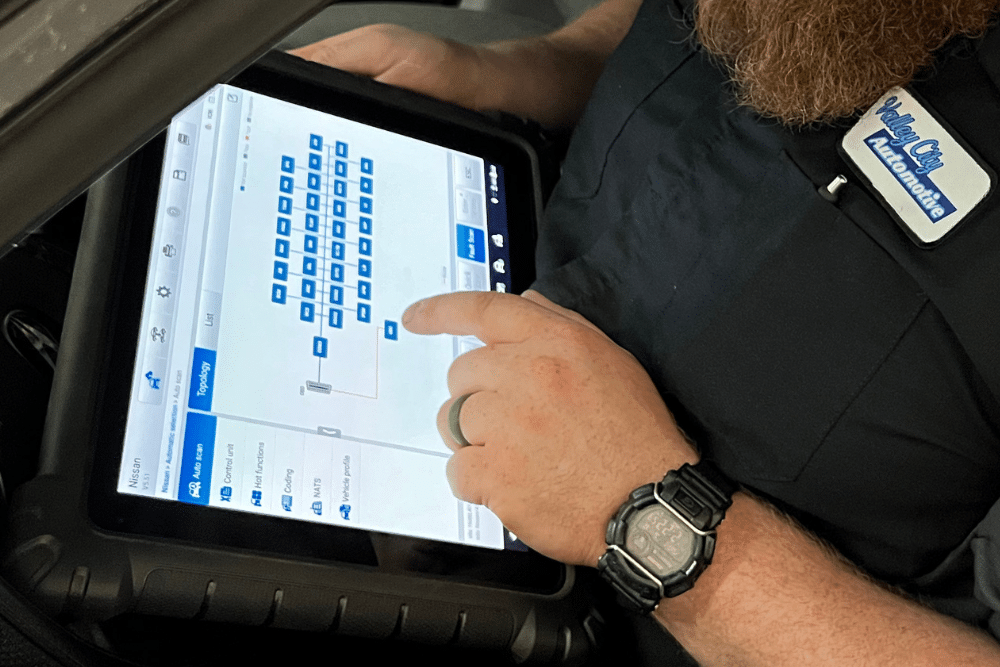
- OEM-level scan tools: We use Autel, Snap-On, TopDon, and factory OEM scanners to pull vehicle data and confirm what the system is telling us
- Pico oscilloscope testing: For blower motor and electrical circuit evaluation, our Pico oscilloscope testing gives us a detailed look at exactly how components are behaving under real operating conditions
- Courtesy Digital Vehicle Inspections: Every vehicle receives a DVI with photo and video documentation so you can see exactly what we found, not just read a description of it
- 60-Month/60,000-Mile Warranty: All qualifying repairs are backed by our nationwide TechNet warranty, a benefit exclusive to our clients through our Shopfix membership partnership
- Financing available: If your repair is more than you planned for, financing is available through our online application at 360 Payments
FAQs About Car Heater Repair in Eau Claire, WI
Why is my car heater blowing cold air?
Your car heater blows cold air most often because of low coolant, a stuck-open thermostat, a blocked heater core, or a blend door actuator that’s preventing air from routing through the heater core properly. A professional heating system evaluation can identify the exact cause so the right repair is made the first time.
What causes a car heater to stop working?
The most common causes are low or degraded coolant, a failed thermostat, a clogged heater core, a faulty blend door or blend door actuator, a failed blower motor, or a worn blower motor resistor. Each of these components plays a specific role in delivering warm air to your cabin, and a failure in any one of them can leave you without heat.
How do I know if my heater core is bad?
A bad heater core often produces a sweet, syrup-like smell inside the vehicle, foggy windows unrelated to weather conditions, cold air from the vents despite the engine being warm, or unexplained coolant loss without visible leaks. If you’re noticing any of these signs, bring your vehicle to Valley City Automotive for a full heating system evaluation.
Can low coolant cause no heat in a car?
Yes. Low coolant is one of the leading causes of a car heater producing no heat, because the heater core depends on a consistent flow of hot coolant to warm the air entering the cabin. Simply topping off the coolant without identifying why it was low can lead to recurring issues and more serious system damage.
Why does my defroster take so long to clear the windshield?
A slow defroster is often a sign that the heating system isn’t reaching full operating temperature quickly enough, which can point to a stuck-open thermostat, low coolant, or a heater core that’s partially blocked. Getting the cooling and heating system tested before winter sets in can resolve the issue and restore normal defroster performance.
Schedule Your Car Heater Repair in Eau Claire, WI Today
Ready to stop guessing and get your heating system tested before winter arrives? Valley City Automotive is here to help drivers across Eau Claire, Altoona, Lake Hallie, Seymour, Mondovi, and Elk Mound, WI get reliable heat before the first hard freeze.
Reach out to us at Valley City Automotive, 1330 Menomonie St., Eau Claire, WI 54703, or call 715-598-7045 to schedule your appointment. We look forward to keeping you and your family warm and safe on the road this winter.